
Introduction
When a new booking is created by Sales, each flight from that booking appears in Dispatch with a "Setup" flag - making it easy to identify flights that are ready to be configured (unless you auto-setup). From there, dispatchers can define what needs to be done, assign responsibility, set required services, and add notes.
FL3XX supports two approaches to flight setup:
- Manual setup - a dispatcher opens each flight and configures it directly.
- Rule-based automatic setup - the system evaluates predefined rules and applies the correct configuration automatically, based on conditions such as aircraft type, route, customer, workflow, and more.
Both approaches share the same underlying setup options. Rules simply allow you to preconfigure and automate tasks that dispatchers would otherwise need to perform manually each time.
Content Overview
1. Accessing Flight Setup & Tasks
5. Auto vs. Manual Flight Setup
5.1 When The Auto Setup is Enabled
5.2 When The Auto Setup is Disabled (Manual Mode)
6. Setting up a Flight Manually
7. Required Services & Handling Requests
7.1 Handling Requests From Rules
9. Rule Application on The Flight Strip
1. Accessing Flight Setup & Tasks
All flight setup configuration is managed under:
-
Settings → Dispatch → Flight Setup & Tasks
This page is organized into two tabs:
- Flight Setup - Manage the Default Flight Setup and all custom rules. [1]
- Tasks - Manage task setup configurations (previously part of the Flight Setup Defaults page).[2]
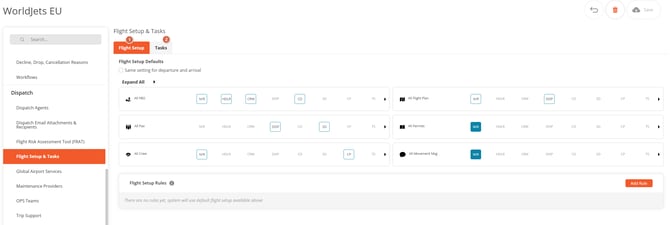
Flight Setup and Tasks settings page
2. Default Flight Setup
A Default Flight Setup is available out of the box. It acts as a universal baseline and is applied to all flights when no custom rules exist or when no custom rule's conditions are satisfied.
- It can be modified at any time to reflect your standard operational template.
- When applied to a flight, it is labeled "Default Flight Setup" on the Flight Setup screen and shown as a clickable link redirecting to Settings → Dispatch → Flight Setup & Tasks → Default Setup.
- Redirection to the configuration page is only available to users with permission to view or edit it.
- Default rule usage is not logged in the flight history.
📝 Note
Treat the Default Flight Setup as the baseline template that should cover the majority of your flights. Custom rules are then used to manage exceptions and special cases on top of this standard.
If your operation is highly complex, most flights will be configured through rules, while only those that do not match any rule will fall back to the Default Flight Setup.
3. "By" Status
Each service in a flight setup is assigned a "By" Status - indicating the party responsible for arranging that service. Available options are:
-
Handler,
-
Crew,
-
Dispatch,
-
Trip Support, or
-
A custom status.
3.1 Custom "By" Status
Custom statuses allow you to clearly delegate responsibility across different departments within your organization.
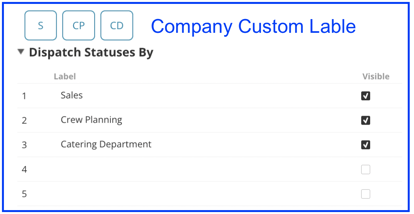
To create your own custom statuses, navigate to Settings → Dispatch Agents. Here you can add a label for each custom status and control its visibility using the Visibility checkbox.
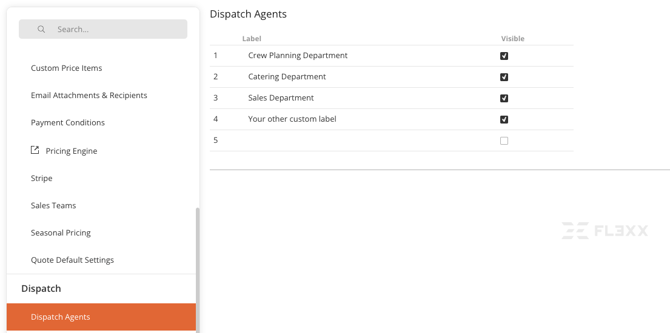
Setting up custom statuses
3.2 Trip Support
FL3XX can automatically route handling requests to your preferred Trip Support company.
To configure this, navigate to Settings → Trip Support and define the list of Trip Support companies you work with. By selecting the "Default" checkbox for a company, all tasks assigned as "By Trip Support" in the flight setup will be automatically sent to that company.

List of preferred Trip Support companies
👁️ Example
If Handling is set to be arranged "By Trip Support" and your default Trip Support is FL3XX Trip, the handling request - along with all other services on that flight marked "By Trip Support" - will be sent to FL3XX Trip in a single request.
Based on the Setup below, the Handling should be arranged by the company's default Trip Support Company, FL3XX Trip, but with the preferred FBO/Ground Handling Company, FL3XX Handling.
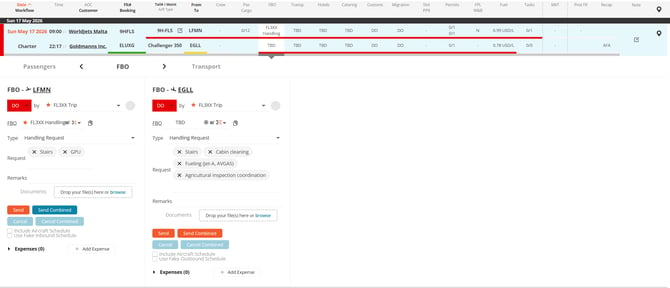
When sending the Handling request, if the DO "By Trip Support" status is present anywhere else on that flight, all services with the DO "By Trip Support" status will be included in the Handling request, which will be set to the selected Trip Support Company.
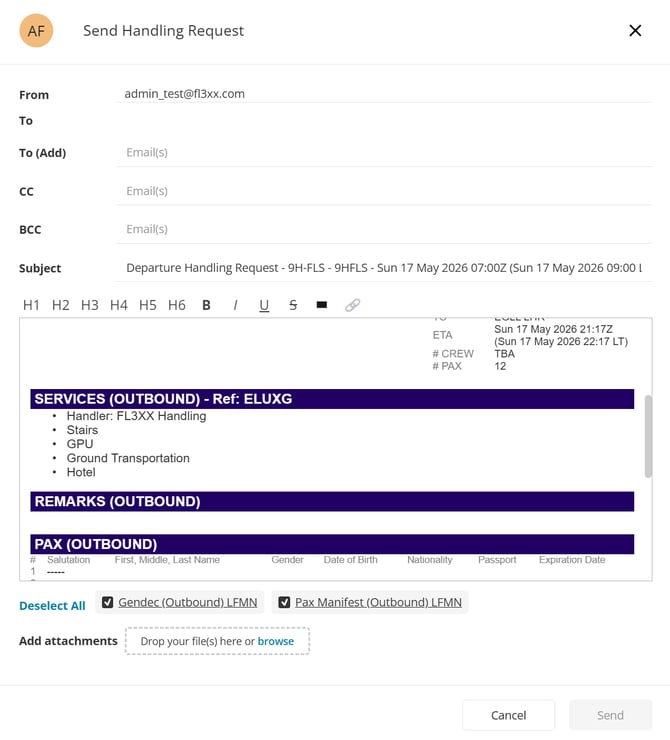
All services are sent to the selected Trip Support Company
3.3 Setting up Defaults
On the same page (Settings), under "Flight Setup Defaults", the standard template for the booking setup can be established.
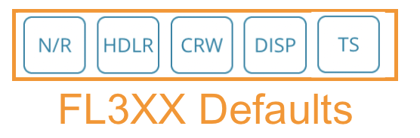
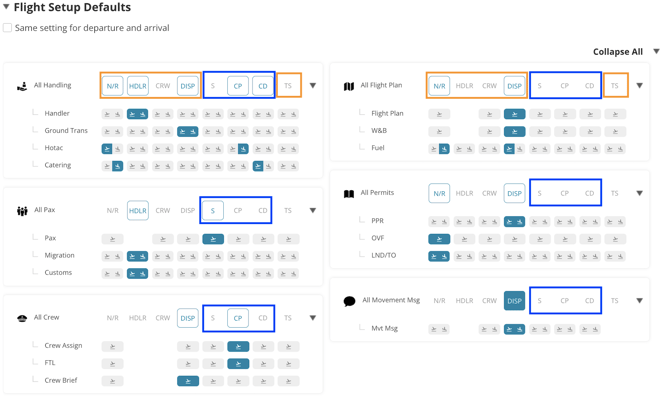
Setting up the standard template for the booking default
4. Rule-Based Flight Setup
Custom rules allow you to override the Default Flight Setup for specific flights based on defined conditions. Instead of dispatchers manually configuring each flight, the system evaluates the rules and applies the correct setup automatically. You can see this in practice in the training videos in our new LMS of computer-based training. The flight setup rules are included as part of the Initial Training course.
Each rule consists of the following elements:
-
Rule Name
A user-defined label identifying the purpose or scope of the rule (e.g., "VIP Charter - Heavy Jet", "US Domestic Departures"). [1] -
Priority
Determines which rule takes precedence when multiple rules match a given flight. Rules are evaluated in ascending order - the lowest number has the highest priority. When two rules share the same priority, they are sorted alphabetically (A–Z). [2] -
Conditions
The criteria that must be met for the rule to apply to a flight. A full list of available conditions is in the Conditions section. Conditions support AND–OR logic for complex matching. [3] -
Flight Setup
The operational configuration applied when the rule's conditions are matched - identical in scope to the existing Default Flight Setup options. [4] -
Handling Requests
Defines which services are applicable within the rule. These can be set to use company/aircraft defaults or specify custom services per departure, arrival, or both. [5]
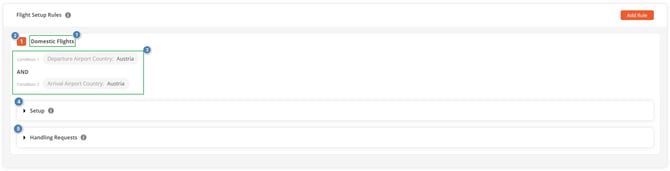
Rule name (1), priority (2), conditions (3), flight setup(4), and Handling Requests (4)
📝 Note
Rules are listed in the Flight Setup tab in order of priority (lowest number at the top), allowing you to quickly review the evaluation order.
4.1 Rule Preview
Each rule in the list displays a preview without needing to open edit mode, showing:
- The conditions under which the rule applies.
- The Flight Setup configuration that will be applied
💡 Tip
To view Flight Setup details without entering edit mode, use the expand/collapse option. [1]
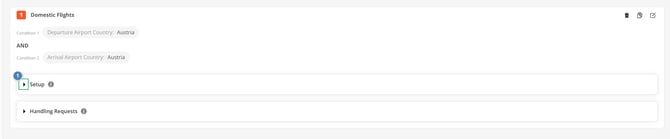
4.2 Duplicating a Rule
You can duplicate any existing rule, which copies its conditions, flight setup, and Handling Requests, allowing you to adjust them as needed. [2]
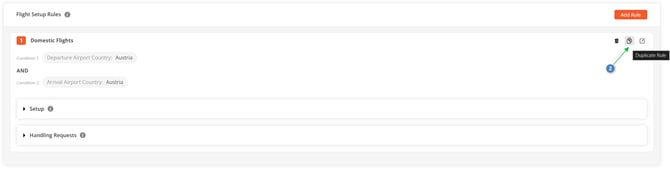 Duplicating a rule
4.3 Creating a Rule
- Navigate to Settings → Dispatch → Flight Setup & Tasks → Flight Setup tab.
- Click "Add Rule".
- Enter a Rule Name that reflects its purpose. [1]
- Set the Priority number. Use lower numbers for specific rules and a high number (e.g., 999) for a broad catch-all rule. [2]
- Define one or more Conditions using AND/OR logic as needed. [3]
- Configure the Flight Setup - select the applicable operational settings. [4]
- Configure Handling Requests - inherit company defaults or define custom services per leg direction. [5]
- Click Save. [6]
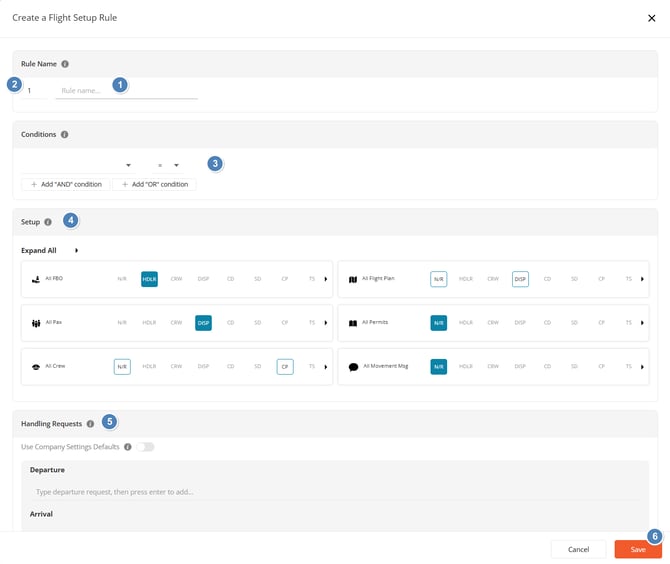
Step-by-step: Add a rule name (1), priority (2), conditions (3), flight setup defaults (4), and Handling Requests (5)
4.4 Rule Priority
The system applies only one rule per flight leg. When evaluating which rule to apply:
- All active rules are sorted by Priority (lowest = highest priority). If priorities are equal, rules are sorted alphabetically (A-Z).
- The system checks each rule's conditions against the flight leg, starting from the top.
- The first rule whose conditions are satisfied is applied.
- If no custom rule matches, the Default Flight Setup is applied automatically.
⭐ Best practices:
- Assign lower priority numbers (e.g., 1, 2, 3) to rules for specific types of operations.
- Use a catch-all rule with a high priority number (e.g., 999) to handle all remaining cases.
5. Auto vs. Manual Flight Setup
How rules are applied depends on the Auto Setup Flights toggle, located under:
Settings → Admin Operator Settings → Configuration → Dispatch → Auto Setup Flights.
5.1 When The Auto Setup is Enabled
When Auto Setup is turned ON:
- Flight setup is applied automatically to every new flight.
- The system selects the highest-priority matching rule or falls back to the Default Flight Setup.
- No Flight Setup button is shown on the Dispatch page - setup occurs without manual intervention.
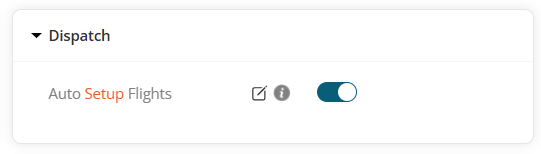
Auto Setup Flights toggle is turned ON
5.2 When The Auto Setup is Disabled (Manual Mode)
When Auto Setup is turned OFF:
- Flight setup is not applied automatically.
- A Flight Setup button is available on the Dispatch page for each flight displaying the "Setup" flag.
- When the dispatcher clicks the button, the system:
- Re-evaluates all rules against the current leg.
- Displays the applicable rule: "The following rule applies to this leg: [RuleName]" [1]
- Shows a preview of the Flight Setup and Handling Requests that will be applied.
- The dispatcher can confirm to apply as shown, or adjust on the fly before confirming.
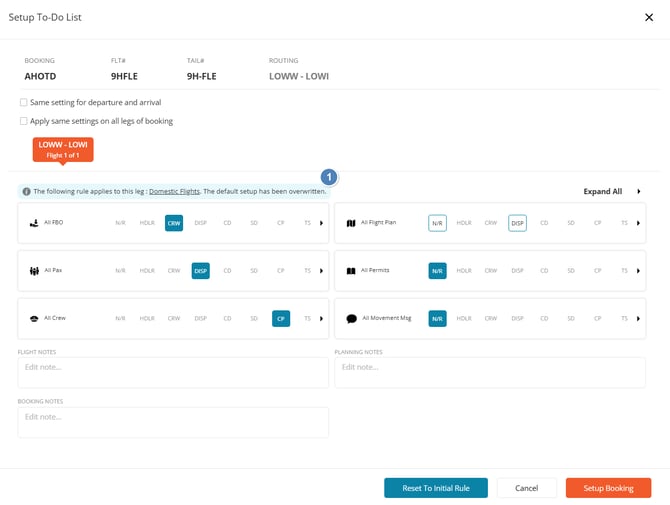
FL3XX indicates that the DomesticFlights rule applies for this leg.
📝 Note:
Whether you use Auto or Manual mode, the same rules and Default Flight Setup are used - the only difference is whether the system applies them automatically or waits for the dispatcher to trigger them.
6. Setting up a Flight Manually
When opening the Flight Setup screen for a specific flight (either via the Setup button or from the flight strip), panels are displayed in compact mode by default. You can expand each panel individually [1] or use "Expand All" [2].
From this screen you can:
- Define what needs to be done - set services, statuses, and responsibilities for each leg.
- Add Notes - flight notes are visible across Web, Dispatch, and Crew apps. Planning and booking notes are visible on Web and Dispatch only (not on the Crew app). [3]
- Review any notes added by Sales - these appear in the Notes field if Sales has already added context.
- Select required services for Departure and/or Arrival where applicable.
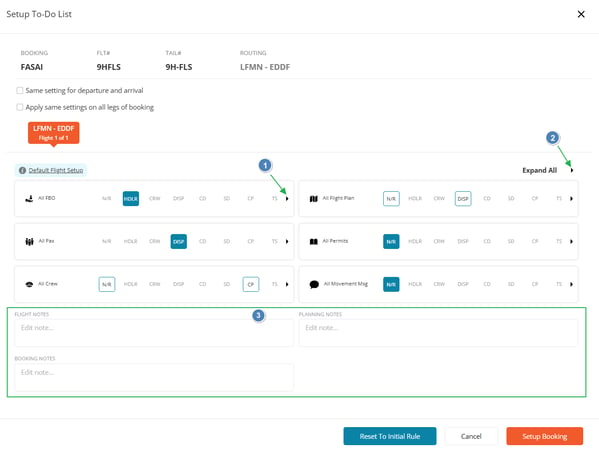
Expand panels individually (1) or all at once (2); and add notes for the flight, booking, or planning (3)
7. Required Services & Handling Requests
Each service in the flight setup can be configured independently for departure and arrival. This allows you to request, for example, catering only at departure and ground transport only at arrival.

Configure the setup independently for departure and arrival
👁️ Example of a typical setup
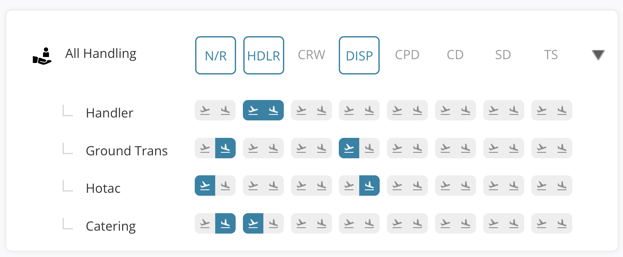
- Handling Services required for both Departure and Arrival → status displayed as DO at both airports.
- Ground Transport required only for Departure → DO at departure airport, not required at arrival.
- Hotac required only for Arrival → DO at arrival airport, not required at departure.
- Catering required only for Departure → DO at departure airport, not required at arrival.
7.1 Handling Requests From Rules
When a rule has configured specific Handling Requests [2], those values override the company/aircraft defaults, as long as "Use Company Settings Defaults" is set to OFF within the rule. [1]
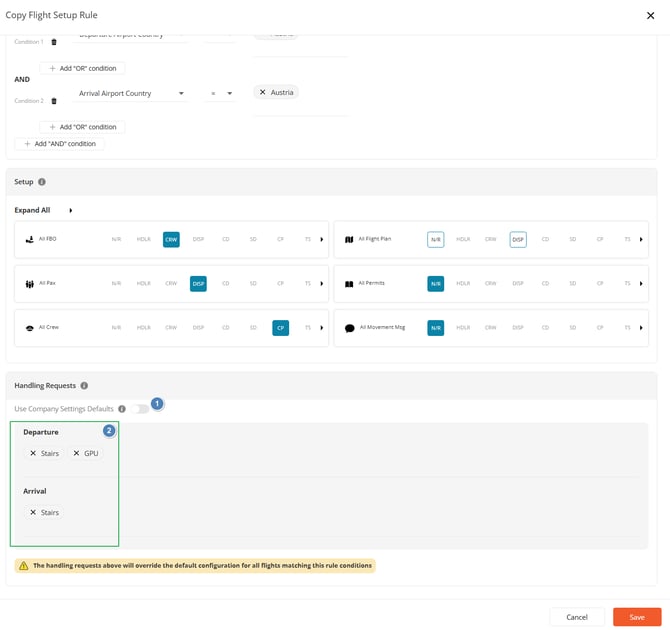
Use the company's default settings (1) or configure specific Handling Requests for this rule (2)
🔑 Key behaviors:
- Custom departure and arrival requests defined in a rule replace the default values when the rule is applied.
- This also applies when one or both handling request fields within the rule are left blank - blank fields still override defaults.
- When "Use Company Settings Defaults" is ON, the company-level defaults are used regardless of rule configuration.
8. Conditions
The following conditions are available when defining rules:
- Account
Select one or more specific accounts from the Account Page. - Aircraft
Select one or more operating aircraft registrations from the fleet. - Aircraft Category
Select one or more aircraft categories as defined on the Aircraft Page. - Aircraft ICAO Type
Select aircraft based on ICAO type(s). - Aircraft OPS Team
Select one or more aircraft groups based on OPS Teams configured in FL3XX Settings. - Aircraft Type
Select the aircraft type: “Commercial” or “Private”. - Arrival Airport
Select one or more arrival airports from the airport database.
- Arrival Airport Country
Select one or more arrival countries from the airport database. - Arrival Airport State
Select one or more states from specific countries for arrival conditions.
- Customer
Select one or more customers from the list maintained in FL3XX. - Departure Airport
Select one or more departure airports from the airport database.
- Departure Airport Country
Select one or more departure countries from the FL3XX database. - Departure Airport State
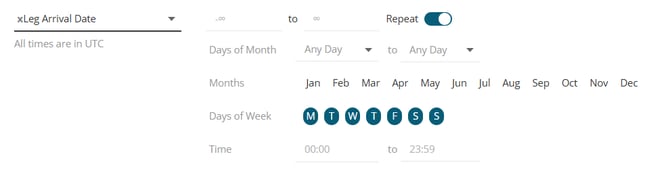
Select one or more states from specific countries for departure conditions. - Leg Arrival Date
Define conditions based on the leg arrival date and time using the advanced date/time selector, including Repeat options fordays of the week, months, days of the month, and time ranges.
- Leg Departure Date
Define conditions based on the leg departure date and time using the advanced date/time selector. Same configuration options as for the Leg Arrival Date. - Leg Distance
- Define distance-based conditions using:
- Equal to
- Less than / Greater than
- Less than or equal / Greater than or equal
- Supported units:
- Statute Miles (SM),
- Nautical Miles (NM),
- Kilometers (km)
- Define distance-based conditions using:
- Leg Flight Hours
Define conditions based on flight hours using:-
- Equal / Not equal to
- Less than / Greater than
- Less than or equal / Greater than or equal
-
- Leg Passengers
Define conditions based on passenger count using:-
- Equal / Not equal to
- Less than / Greater than
- Less than or equal / Greater than or equal
-
- Leg Patients
Define conditions based on the number of patients on the leg using:-
- Equal / Not equal to
- Less than / Greater than
- Less than or equal / Greater than or equal
-
- Leg Settings
Define conditions based on specific leg settings from the Sales Itinerary:-
- Tech Stop
- Fuel Stop
- Date TBA
-
- Workflow
Define conditions based on the workflow name configured in Settings → Workflow. - Workflow Type
Define conditions based on the workflow type configured in Settings → Workflow. - Pax
Define conditions based on passengers added to the flight. The system checks any passenger present in the Pax list. The condition is satisfied if at least one matching passenger is found. - Pax Lead
Define conditions based on the lead passenger (the first passenger in the Pax list). The condition is satisfied if the lead passenger matches the defined criteria.
9. Rule Application on The Flight Strip
The Flight Setup view on the flight strip always shows which rule has been applied to the flight, providing full transparency over automated or manually applied configurations.
From the Flight Setup view on the flight strip, you can:
- See the applicable rule - the rule name is displayed as a reference for the applied configuration. [1]
- Manually adjust any values, overriding rule-defined settings before or at the time of application.
- Recalculate the applicable rule - if flight details have changed (e.g., aircraft reassigned, passenger list updated), you can trigger a re-evaluation. The system warns you that the flight setup may change before you confirm.
- Reset to Initial Rule - restores the original flight setup values based on the rule applicable to that leg, reverting any manual changes. [2]
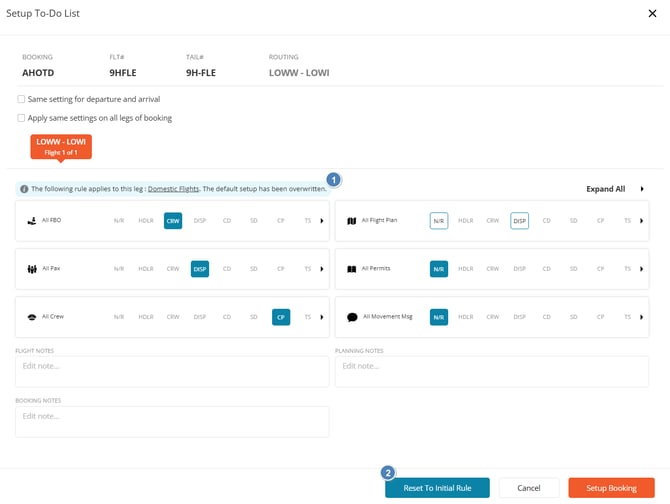
In the Flight Setup view you can see the applicable rule (1) and reset to the initial rule (2)
10. Multi-Leg Flights
Each leg in a multi-leg booking is evaluated independently against all rules.
-
Before setup is applied
Any change to a leg (aircraft, route, passengers) triggers a re-evaluation of applicable rules for that leg. [1] -
After setup is applied
The flight setup for that leg becomes locked - it is a one-time action and cannot be re-applied. Future rule updates apply only to new bookings or new legs. -
Applying the same setup across all legs
When "Apply same settings on all legs of the booking" is selected, the flight setup from the selected leg is applied uniformly to all legs in the booking, regardless of which rule would individually apply to each leg. [2] -
Applying the same setting for Departure and Arrival
Use the "Same setting for Departure and Arrival" option to mirror service selections across both sides of a leg in a single action. [3]
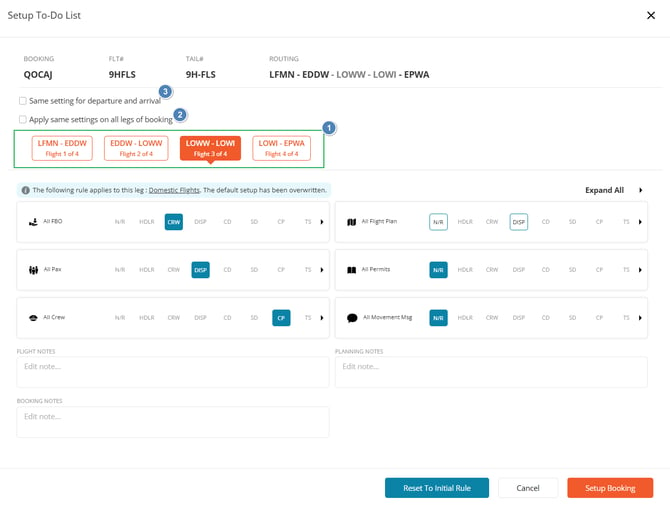
Switch between different legs (1), select to apply the same settings on all legs of a booking (2), and select to apply the same selection for both, departure and arrival (3)
11. History Logging
Rule applications are recorded in the flight history for auditability:
- Custom rule applied → logged as:
flightSetupRule → [RuleName] - Default Flight Setup applied → not logged in history.
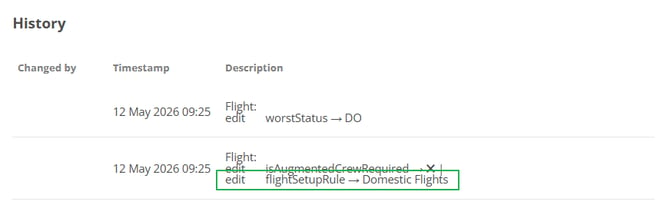
The custom rule "Domestic Flights" has been applied on 12 May 2026 at 09.25